

couples therapy Chicago

How Marriage Counselling Can Improve Communication and Emotional Connection

Do you and your spouse still care deeply about each other but find it harder to communicate or feel as close as you once did?

Communication problems do not necessarily mean a marriage is failing. Stress, parenting, work, finances, unresolved disagreements, and changing responsibilities can gradually affect how partners speak to and connect with one another.

Marriage counselling in Chicago can provide a structured space to understand those patterns, communicate needs more clearly, and work toward greater emotional connection.

At Wellman Psychology, we recognize that many couples are not looking for someone to decide who is right. They want help understanding why the same conversations keep going wrong and how they can begin reaching each other differently.

Can Marriage Counselling Improve Communication?
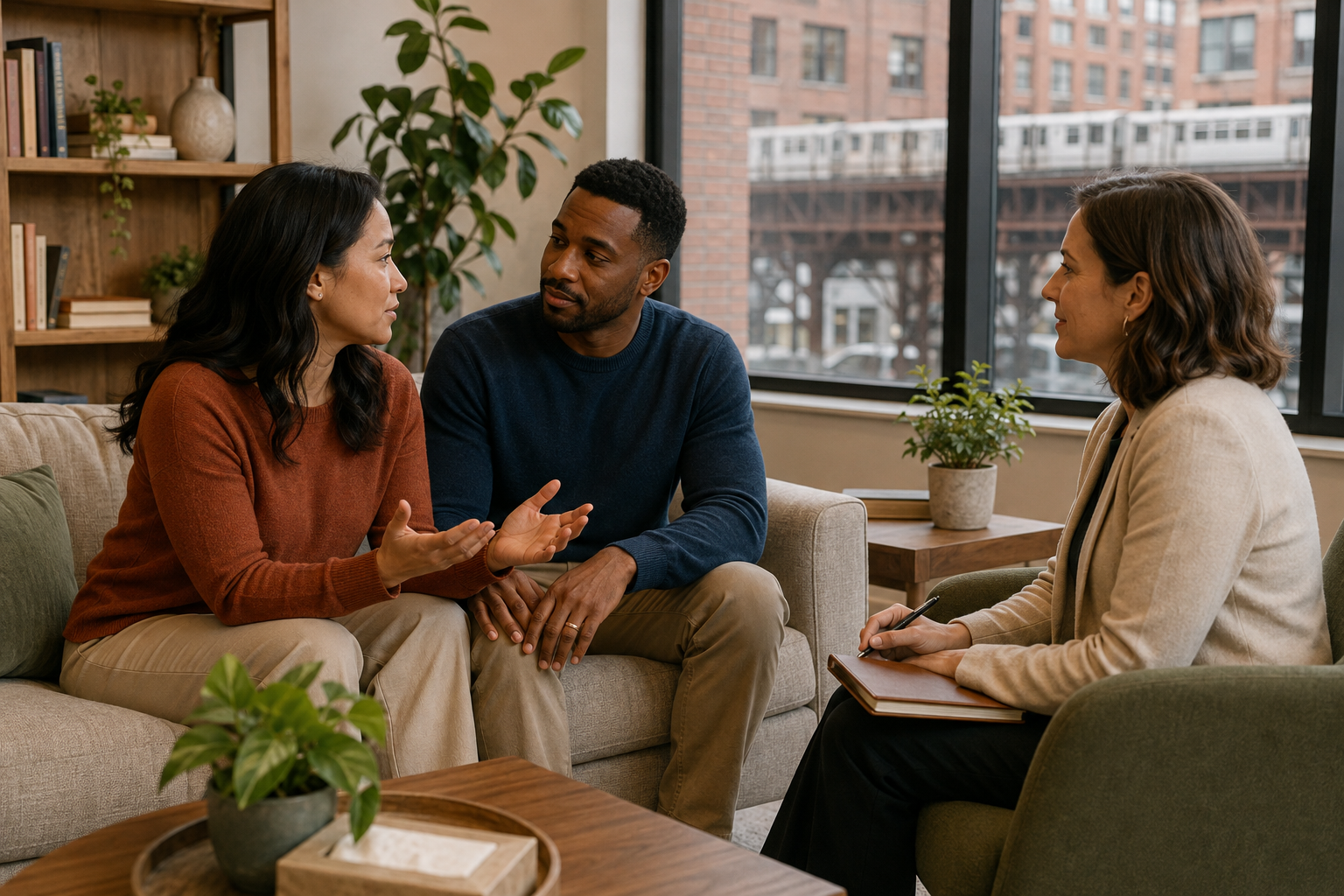
Marriage counselling in Chicago helping spouses improve communication and emotional connection

Marriage counselling can help couples identify unhealthy communication patterns, express their needs more clearly, listen with greater understanding, and develop healthier approaches to conflict.

Communication and emotional connection are closely related. When you feel heard and understood, it is often easier to be vulnerable. When conversations repeatedly involve criticism, defensiveness, withdrawal, or arguments, you may eventually stop sharing what you actually feel.

This can create a frustrating situation where both partners want to feel closer but neither knows how to reach the other.

Therapy can slow that process down. Instead of focusing only on the latest argument, couples can explore the pattern underneath it and begin identifying where something could change.

Why Do Communication Problems Develop in Marriage?

Most communication problems do not appear overnight.

A couple may begin with relatively small misunderstandings. One partner feels unheard and becomes more persistent. The other feels criticized and begins withdrawing. The more one person pushes for conversation, the more the other pulls away.

Over time, that reaction can become automatic.

Communication may also become harder because of:

  • Work or financial stress

  • Parenting responsibilities

  • Different expectations

  • Unresolved arguments

  • Changes in intimacy

  • Major life transitions

  • Different communication styles

  • Feeling unappreciated

  • Difficulty expressing emotional needs

Busy schedules can make the situation worse. When most conversations become about work, children, bills, appointments, and responsibilities, couples may spend very little time actually talking about how they feel.

The important thing is that these patterns can be recognized and worked on.

How Does Marriage Counselling Help Couples Communicate Better?

Telling a couple to “communicate more” is rarely enough. Many struggling couples already talk frequently. The problem is often what happens during those conversations.

Recognizing Communication Patterns

A therapist can help identify patterns that may be difficult to notice when you are inside them.

For example, one partner might say, “You never listen to me.” The other responds, “Because you're always criticizing me.” The first partner then becomes even more frustrated because they feel ignored.

Both people continue talking, but neither feels understood.

Therapy can help couples stop focusing entirely on the words being exchanged and look at the cycle that keeps the conversation going in the same direction.

Expressing Needs Instead of Criticism

There is an important difference between describing what you need and attacking your partner.

Instead of saying:

“You never spend any time with me.”

you might say:

“I've been feeling disconnected lately, and I'd like us to spend more intentional time together.”

The second statement gives your partner clearer information about what you are experiencing and what might help.

Listening to Understand

Healthy communication requires more than waiting for your turn to speak.

Active listening may involve asking questions, reflecting back what you heard, acknowledging your partner's emotions, and taking a moment before responding defensively.

You do not have to agree with everything your spouse says. The goal is to make sure you understand their experience before explaining your own.

Handling Conflict Differently

Healthy marriages still include disagreement.

Marriage counselling is not designed to eliminate every argument. Instead, couples can learn how to disagree without repeatedly damaging the emotional connection between them.

That may involve noticing when a conversation is escalating, taking a productive break, avoiding personal attacks, and returning to the issue when both partners are better able to communicate.

Can Marriage Counselling Help You Feel Emotionally Connected Again?

Yes. Communication is often closely tied to emotional intimacy.

You can live in the same home, share meals, raise children, manage finances, and still feel emotionally distant.

Connection involves feeling that your spouse hears you, values you, understands what matters to you, and is emotionally available when you need support.

When communication repeatedly becomes painful, one or both partners may begin protecting themselves. You might stop bringing up concerns because you expect an argument. You may stop asking for affection because rejection feels likely. Conversations become more practical and less personal.

Therapy can help couples begin reversing those patterns by creating space for needs, concerns, and vulnerabilities to be expressed more clearly.

What Does Healthy Communication Look Like?

Healthy communication does not require every sentence to be perfect.

It usually means communicating in ways that create more opportunity for understanding and less opportunity for immediate defensiveness.

Instead of:

“You never listen to me.”

Try:

“I feel unheard when I'm speaking and the conversation gets interrupted.”

Instead of:

“You always make everything about you.”

Try:

“I want to feel like my concerns have space in the conversation too.”

Instead of shutting down with:

“Fine. I just won't talk about it.”

you might say:

“I'm getting overwhelmed and need a short break. Can we come back to this later?”

The goal is not to sound scripted. It is to reduce blame enough for the real issue to remain part of the conversation.

How Can Couples Break Repeating Argument Cycles?

Many couples experience predictable patterns that look something like:

Trigger → reaction → escalation → withdrawal → unresolved feelings → repeat

For example, one partner asks for more affection. The other hears the request as criticism and becomes defensive. The first person becomes frustrated because they do not feel heard, and the second begins withdrawing.

Neither person gets what they originally needed.

Once this happens often enough, both partners may begin believing the other person is the problem.

Marriage counselling can help shift the focus toward the pattern instead.

A therapist may help you explore what triggers the cycle, what emotions sit underneath each reaction, what each person actually needs, and where either partner could respond differently.

That can turn conflict from “me versus you” into something the couple can begin addressing together.

What If One Spouse Feels More Disconnected?

It is common for partners to enter therapy with different views of the relationship.

One person may feel that something is seriously wrong while the other believes things are mostly fine. That difference can create frustration before counselling even begins.

Neither experience necessarily has to be dismissed.

Two people can be in the same marriage and experience it differently. Therapy gives both partners an opportunity to explain what they are seeing and feeling.

Even when they begin with different concerns, couples may discover that they share similar goals: feeling understood, arguing less, becoming closer, or functioning more like a team.

What Can You Do Between Marriage Counselling Sessions?

Progress is reinforced by what happens outside therapy.

Small habits can help:

  • Schedule regular check-ins

  • Put phones away during important conversations

  • Express appreciation more often

  • Ask what your partner needs instead of assuming

  • Address concerns before resentment builds

  • Avoid using old mistakes as weapons during new arguments

  • Take a break when emotions become overwhelming

  • Return to the conversation after the break

You do not need to change everything at once.

Sometimes consistently practicing one or two healthier habits can begin changing how conversations feel.

When Should You Consider Marriage Counselling?

You do not have to wait until your relationship reaches a crisis.

You may want to consider counselling if:

  • The same arguments keep happening

  • Difficult conversations quickly become defensive

  • One or both partners feel misunderstood

  • Emotional connection has decreased

  • Important topics are being avoided

  • Resentment is building

  • Intimacy has changed

  • You struggle to express your needs

  • You want to strengthen an otherwise healthy marriage

Marriage counselling can also provide support during major transitions such as becoming parents, moving, career changes, financial pressure, or other events that change the way responsibilities are shared.

Why Choose Wellman Psychology?

At Wellman Psychology, we understand that every marriage has its own history, personalities, communication styles, strengths, and challenges.

Some couples come to therapy after years of recurring conflict. Others are experiencing emotional distance, trust concerns, parenting disagreements, financial stress, or changes in intimacy.

Others simply want to strengthen their relationship before smaller problems become more difficult.

Our approach to marriage counselling in Chicago is designed around the needs and goals of the couple rather than applying the same solution to every relationship.

The goal is to provide a supportive environment where both partners can share their perspectives, better understand the patterns affecting their marriage, and work toward healthier ways of communicating and connecting.

Frequently Asked Questions About Marriage Counselling

Can marriage counselling improve communication?

Yes. Marriage counselling can help couples recognize unhealthy patterns, express needs more clearly, practice active listening, and approach conflict differently.

Can marriage counselling help couples reconnect emotionally?

It can. Improving communication and emotional safety can make it easier for partners to express vulnerability, understand one another's needs, and rebuild closeness.

What happens during marriage counselling?

Sessions generally provide a structured environment to discuss relationship concerns with guidance from a therapist. Depending on your goals, therapy may focus on communication, conflict, trust, intimacy, emotional connection, or other concerns.

What if my spouse does not want counselling?

If your partner is unwilling to attend, individual therapy may still help you explore your own emotions, communication habits, needs, boundaries, and relationship concerns.

How long does marriage counselling take?

There is no single timeline. The number of sessions depends on the concerns you want to address, your goals, progress, and the therapeutic approach.

Is marriage counselling only for serious problems?

No. Couples can use therapy proactively to improve communication, strengthen emotional connection, prepare for major transitions, or develop healthier relationship skills.

Better Communication Can Create Deeper Connection

A strong marriage does not require two people who never disagree. It requires partners who can learn how to move through disagreements without repeatedly damaging their connection.

When communication improves, it can become easier to express needs, listen to one another, repair after conflict, and become emotionally vulnerable again.

If communication has become difficult in your marriage, you do not have to wait until the relationship feels unmanageable.

At Wellman Psychology, we support couples who want to communicate more effectively, reconnect emotionally, and develop healthier relationship patterns.

Schedule an appointment with Wellman Psychology to learn more about marriage counselling in Chicago and whether it may be the right next step for you and your spouse.

Follow Wellman Psychology for additional mental health resources and updates:

Related Articles

How Relationship Counselling in Chicago Can Help Rebuild Trust After Conflict

When a difficult argument leaves behind hurt, resentment, or emotional distance, moving forward can feel harder than simply saying, “Let’s put this behind us.”

Trust usually does not return after one apology or one good conversation. It is rebuilt through honesty, accountability, emotional safety, and consistent actions over time.

Relationship counselling in Chicago can give couples a structured place to talk about what happened, understand each other's experiences, and begin changing the patterns that continue creating conflict.

At Wellman Psychology, we understand that trust can be affected even in relationships that once felt secure and connected. Therapy can help couples slow difficult conversations down and focus not only on what happened, but also on what may need to change moving forward.

Can Relationship Counselling Help Rebuild Trust?

Relationship counselling in Chicago helping a couple rebuild trust after conflict

Relationship counselling can support trust repair by helping partners discuss what happened, communicate more openly, understand harmful patterns, take responsibility, and develop healthier ways of responding to conflict.

Trust can be surprisingly fragile. One disagreement may not permanently damage a relationship, but repeated arguments, dishonesty, broken promises, secrecy, or unresolved resentment can gradually make one or both partners feel less secure.

That is why saying “I'm sorry” may be an important beginning, but it is rarely the entire process.

The partner who was hurt may need to see consistent change. The person who caused the hurt may need to understand the impact of their behavior without immediately becoming defensive.

A therapist can create space for both experiences while helping the couple identify practical changes that support greater trust and emotional safety.

Why Can Conflict Damage Trust?

Conflict itself is not necessarily unhealthy. Couples can disagree and still have strong relationships.

The bigger issue is often how conflict is handled.

Imagine a disagreement about finances. One partner becomes defensive, the other responds with criticism, and suddenly the conversation is no longer about money. Old mistakes are brought up, voices rise, and one person eventually walks away.

One partner feels abandoned. The other feels attacked. The original problem remains unresolved.

When the same cycle happens repeatedly, both people may begin expecting conversations to go badly before they have even started.

One person may think, “I can't bring anything up without it becoming an argument.” The other may feel, “Nothing I say is ever good enough.”

Relationship counselling can help couples recognize these patterns rather than treating every new disagreement as an isolated problem.

What Does Rebuilding Trust Actually Involve?

Trust repair is usually a process. Although every relationship is different, several steps can be especially important.

1. Acknowledge What Happened

Repair begins with recognizing that something caused hurt.

You do not necessarily need to agree on every detail of the situation. However, both people need enough space to explain how they experienced what happened and why it affected them.

Feeling heard does not automatically resolve the conflict, but it can create a foundation for moving forward.

2. Take Responsibility

Accountability is different from accepting blame for everything.

It means recognizing your own actions and their impact without immediately explaining them away.

For example, saying, “I understand that when I stopped responding during the argument, you felt ignored,” creates more room for repair than, “I only stopped responding because you were being impossible.”

The first response acknowledges the impact. The second immediately shifts responsibility back to the other person.

3. Listen Before Defending Yourself

When someone says you hurt them, the instinct to explain yourself can be strong.

Sometimes, however, the first goal should simply be understanding what the other person experienced.

There may be time to explain your perspective later. Listening first can make it easier for your partner to feel heard and can reduce the likelihood that the conversation immediately turns into another argument.

4. Follow Through Consistently

Trust is built through repeated experiences.

If you say you will communicate differently, keep a promise, or change a behavior, your partner will usually need to see that change consistently before they feel confident relying on it.

Small actions matter. Honesty, reliability, following through, and doing what you said you would do can gradually create a different relationship experience.

5. Create More Emotional Safety

Partners need to know that difficult conversations can happen without automatically becoming destructive.

That does not mean disagreements disappear. It means both people begin learning how to manage those disagreements without insults, constant defensiveness, withdrawal, or escalation.

How Can Couples Communicate Better After Conflict?

After a major argument, avoiding the topic may feel easier. A short pause can be useful when emotions are high, but avoiding the conversation indefinitely often leaves the underlying issue unresolved.

A few habits can make difficult discussions more productive:

  • Choose the right time. Serious conversations are harder when someone is exhausted, distracted, or already overwhelmed.

  • Talk about your experience. “I felt dismissed when…” is usually easier to respond to than “You never listen.”

  • Avoid absolutes. Words such as “always” and “never” can shift the conversation toward defending yourself rather than understanding the issue.

  • Listen before responding. Make sure you understand what your partner is actually saying.

  • Pause when necessary. If emotions become overwhelming, agree to take a break and return to the conversation.

  • Follow up. Not every difficult issue has to be completely resolved in one sitting.

These habits can take practice, especially when a couple has been communicating differently for years.

Can Therapy Help Stop the Same Arguments From Repeating?

Yes. One useful part of relationship therapy can be identifying the cycle underneath recurring disagreements.

A common pattern might look something like:

Trigger → reaction → escalation → withdrawal → unresolved feelings → repeat

One partner may ask for more connection. The other hears criticism and becomes defensive. The first person becomes more frustrated because they feel ignored, which causes the second person to withdraw further.

Eventually, both people are reacting to each other's reactions rather than talking about what either person actually needs.

A therapist can help slow that cycle down and explore what happens at each stage. Instead of focusing entirely on who started the argument, therapy can look at what each person felt, what caused the conversation to escalate, and what either partner could do differently the next time.

The goal is not to eliminate disagreement. It is to change what happens once disagreement begins.

What If One Partner Caused More Harm?

Rebuilding trust does not mean pretending that both partners are equally responsible for every situation.

Sometimes one person's actions have caused substantially more harm. If someone lied, broke an important promise, or behaved in another way that damaged trust, acknowledging that behavior and demonstrating meaningful change remain important.

There is a difference between shared responsibility for improving the relationship and shared responsibility for a specific harmful action.

Those are not always the same thing.

If the relationship involves abuse, coercion, intimidation, or safety concerns, couples therapy may not be appropriate in every situation. A qualified mental health professional can help determine what kind of support is suitable.

How Long Does It Take to Rebuild Trust?

There is no universal timeline.

Some couples may begin feeling more hopeful after several productive conversations. For others, rebuilding trust can take considerably longer, particularly when hurt has occurred repeatedly.

The process may depend on how serious the rupture was, whether the damaging behavior has stopped, how consistently changes are maintained, and how long the relationship has been affected.

Trying to rush the process can sometimes create more pressure.

Consistency is usually more meaningful than making one dramatic gesture. A pattern of honesty and reliability over time may gradually provide a different experience from the one that damaged trust in the first place.

What Can You Do Between Counseling Sessions?

What happens outside therapy matters too.

You can reinforce the work you are doing by:

  • Keeping promises and commitments

  • Checking in regularly

  • Practicing active listening

  • Expressing appreciation

  • Avoiding using old conflicts as weapons

  • Taking productive pauses during heated conversations

  • Returning to difficult topics instead of avoiding them

  • Asking what your partner needs

  • Noticing progress, even when it is gradual

One healthy conversation may not undo months or years of hurt. A pattern of healthier conversations can gradually change how the relationship feels.

When Should You Consider Relationship Counselling?

You do not have to wait until the relationship reaches a breaking point.

Consider professional support if the same arguments keep returning, conversations quickly become defensive, trust has been damaged, resentment is building, or you struggle to repair after disagreements.

Counselling can also be useful when you simply recognize that you and your partner are having trouble communicating effectively.

Some couples use therapy proactively, before problems become deeply established. The goal does not always have to be fixing a crisis. It can also be strengthening the relationship and learning better ways to handle future challenges.

Why Choose Wellman Psychology?

At Wellman Psychology, we recognize that every relationship has its own history, strengths, communication patterns, and challenges.

Couples may come to therapy because of recurring conflict, damaged trust, emotional distance, intimacy concerns, major transitions, or simply the feeling that they are no longer communicating the way they want to.

Our approach is centered on understanding the relationship in front of us rather than applying the same solution to every couple.

For people looking for relationship counselling in Chicago, therapy can provide a more structured environment for conversations that may repeatedly become difficult at home.

The goal is not to determine which partner “wins.” It is to understand what has happened, what is keeping you stuck, and what meaningful change may look like for your relationship.

Frequently Asked Questions About Rebuilding Trust

Can relationship counselling really rebuild trust?

Counselling can support trust repair by helping couples discuss what happened, improve communication, practice accountability, and develop more consistent patterns. Trust itself generally returns gradually through repeated actions.

How long does it take to rebuild trust?

There is no set timeline. It depends on the seriousness of what happened, how long trust has been affected, whether harmful behavior has stopped, and how consistently meaningful changes are maintained.

Can a relationship recover after repeated arguments?

Recurring conflict is a common reason couples seek therapy. Counselling can help identify the pattern underneath those arguments and support healthier ways of responding.

What should you do when your partner no longer trusts you?

Begin with accountability rather than defensiveness. Listen to the impact of your actions, avoid making promises you cannot keep, and focus on demonstrating consistent change.

Should couples seek counselling after one major conflict?

They can. You do not need to wait until a problem has existed for years. Professional support may help couples process a significant conflict before resentment or emotional distance increases.

Rebuilding Trust Starts With Consistent Change

Trust rarely returns because of one perfect conversation.

It is more often rebuilt in smaller moments: following through on a promise, listening instead of becoming defensive, approaching a disagreement differently, or pairing an apology with genuine change.

If conflict has left you and your partner feeling disconnected, you do not necessarily have to figure out the next step alone.

At Wellman Psychology, relationship counselling can provide a structured space to understand what happened, identify the patterns keeping you stuck, and explore healthier ways to communicate and reconnect.

If you are ready to begin that conversation, schedule an appointment with Wellman Psychology to explore relationship counselling in Chicago.

Follow Wellman Psychology for additional mental health resources and updates:
Related Articles

What Happens During Your First Couples Counseling Session?

Considering couples counseling can bring up a lot of questions. What will the therapist ask? Will you have to talk about your biggest problems immediately? What happens if you and your partner start arguing during the appointment?

Your first session is generally about helping the therapist understand your relationship, what brought you to therapy, and what you both hope will change. You do not need to arrive with everything figured out or a perfectly organized explanation of your relationship.

At Wellman Psychology, we understand that asking for support can feel like a significant step. Couples counseling in Chicago can give you and your partner a structured space to slow down, better understand what is happening between you, and begin working toward healthier ways of communicating and connecting.

What Happens During Your First Couples Counseling Session?

First couples counseling session with a therapist and couple

The first appointment typically begins with your therapist getting to know you as a couple. They may ask how long you have been together, what brought you to counseling now, what has been difficult recently, and what you each hope to accomplish.

Both partners should have an opportunity to explain their perspective. Your answers may be different, and that is okay. One person might say, “I want us to stop arguing,” while the other says, “I want us to feel close again.” Those answers may sound different, but they can both help the therapist understand what is happening in the relationship.

You may also talk about what is working well. Understanding your strengths as a couple can be just as useful as identifying areas that need attention.

By the end of the first session, your therapist may begin identifying initial goals, such as improving communication, managing recurring conflict, rebuilding trust, strengthening emotional intimacy, or navigating a major life transition.

You are not expected to solve everything in one appointment. The first session is a starting point.

What Questions Will a Couples Therapist Ask?

Your therapist will likely ask questions about both your relationship history and your current concerns.

Examples may include:

  • What brought you to counseling now?

  • What are the biggest challenges in your relationship?

  • What do you appreciate about each other?

  • How do disagreements usually begin?

  • What happens when one of you becomes upset?

  • How do you normally resolve conflict?

  • What have you already tried?

  • What would you like to be different?

  • What do you hope to accomplish through counseling?

The therapist may also pay attention to how you communicate during the session. Perhaps one person becomes quiet when conflict comes up while the other becomes increasingly persistent. Maybe one partner wants to resolve everything immediately while the other needs time to process.

Recognizing patterns like these can help your therapist understand not just what you argue about, but how conflict develops between you.

Will the Therapist Take Sides?

This is one of the most common concerns couples have before starting therapy.

Couples counseling is generally not about deciding which partner is right or wrong. Instead, the therapist tries to understand the relationship dynamic and how each person's reactions may affect the other.

For example, one partner may push for a conversation because they feel ignored. The other may withdraw because they feel criticized. The withdrawal then makes the first person feel even more ignored, so they push harder.

Therapy can help make that cycle visible.

This does not mean every action in a relationship is treated as equally acceptable. Concerns involving abuse, coercion, or safety require appropriate clinical attention. For typical relationship conflict, however, the focus is usually on understanding patterns and developing healthier ways to respond.

What If You Start Arguing During the Session?

Arguing in front of a therapist may feel embarrassing, but it can sometimes provide useful information.

If a disagreement begins during therapy, your therapist may help slow the interaction down rather than simply allowing the argument to continue.

They might ask what each person was feeling, what they needed in that moment, what caused the conversation to escalate, and how each response affected the other person.

This can help you recognize the cycle underneath the disagreement.

The goal of couples counseling is not to eliminate every argument. Healthy relationships still involve disagreement. Instead, therapy can help you develop better ways of navigating those moments without repeatedly getting trapped in the same pattern.

How Should You Prepare for Your First Couples Counseling Session?

You do not need to spend hours preparing. A few minutes of reflection can be enough.

Before your appointment, consider:

Why Are We Seeking Counseling?

Try to identify the main concerns that brought you to therapy. You may have several, but understanding the biggest ones can make it easier to explain what you need.

What Would I Like to Change?

Think beyond what you want your partner to do differently. Consider what you would like to change about the relationship itself and what you may personally be able to contribute.

What Is Already Working?

It is easy to focus entirely on problems. Think about the strengths in your relationship, what originally brought you together, and what you still value about your partner.

What Have We Already Tried?

Maybe you have tried weekly check-ins, spending more time together, taking breaks during arguments, or avoiding a particular topic altogether. Letting your therapist know what has and has not helped provides useful context.

What Should You Avoid Before Your First Session?

Try not to approach couples therapy like a court case.

You do not need to prepare a list of every mistake your partner has made or collect examples to prove that you are right. Entering the session focused entirely on convincing the therapist that your partner is the problem can make it harder to explore the relationship itself.

A more useful question may be:

“What keeps happening between us, and what could we both do differently?”

That does not mean accepting blame for everything. It means approaching therapy with enough curiosity to understand the patterns affecting your relationship.

What Happens After the First Couples Counseling Session?

Once your therapist understands your relationship more clearly, later sessions typically become more focused on your goals.

Depending on what brings you to therapy, you may work on:

  • Communication

  • Conflict resolution

  • Emotional intimacy

  • Trust

  • Boundaries

  • Relationship expectations

  • Family or parenting concerns

  • Major life transitions

  • Recurring disagreements

  • Intimacy and connection

Your therapist may also introduce exercises or communication strategies to practice between appointments.

The goal is not simply to spend an hour each week talking about what went wrong. Couples counseling can also help you practice new ways of responding to one another and gradually change patterns that have become difficult to manage.

How Many Couples Counseling Sessions Will You Need?

There is no universal number of sessions.

Some couples seek short-term support for one specific concern, while others benefit from longer-term therapy when the issues are more complex or have developed over many years.

The length of therapy may depend on your goals, the concerns being addressed, how long those patterns have existed, and how the therapeutic process progresses.

Your goals can also evolve. You may initially come in because of frequent arguments and later realize that emotional distance or difficulty expressing your needs is a larger part of the problem.

Therapy can adjust as your understanding of the relationship changes.

What If Your Partner Does Not Want Couples Counseling?

You cannot force another person to participate meaningfully in therapy.

If your partner is hesitant, it may help to explain why counseling matters to you without presenting it as punishment.

Instead of saying, “You need therapy,” you might explain that you want support understanding why the same problems keep happening and would like to work on the relationship together.

If your partner still does not want to participate, individual therapy can give you space to understand your own emotions, needs, boundaries, and communication patterns.

Why Choose Wellman Psychology?

At Wellman Psychology, we recognize that no two relationships are exactly alike.

Some couples seek support because communication has become difficult. Others are trying to rebuild trust, reconnect emotionally, navigate a major transition, or understand why the same arguments keep happening.

Others simply want to strengthen a relationship that is already important to them.

Our approach to couples counseling focuses on creating a space where both partners can participate honestly and where therapy is shaped around the relationship's specific needs and goals.

If you are considering couples counseling in Chicago, your first appointment does not require you to have the right answers. It is simply an opportunity to begin explaining what is happening and determine what kind of support may be useful.

Frequently Asked Questions About Your First Couples Counseling Session

What should I say in my first couples therapy session?

Start by explaining why you decided to seek counseling, what has been difficult, and what you would like to improve. You do not need to explain your entire relationship perfectly.

Will a couples therapist tell us who is right?

Generally, no. Couples therapy focuses on understanding both perspectives and the patterns affecting the relationship rather than choosing a winner.

Can couples counseling help if we argue a lot?

Yes. Therapy can help couples understand recurring conflict patterns and practice healthier ways of communicating and responding to each other.

How long does couples counseling take?

There is no fixed timeline. The length of therapy depends on your concerns, goals, progress, and therapeutic approach.

Is it normal to feel nervous before couples counseling?

Yes. Talking about personal relationship concerns with someone new can feel uncomfortable. You are not expected to know exactly what to say before arriving.

Your First Session Is a Starting Point

Walking into a couples counseling appointment does not mean your relationship has failed.

You do not need to solve every problem before your first session, agree about exactly what is wrong, or know what therapy should ultimately accomplish. You simply need to be willing to begin the conversation.

At Wellman Psychology, we believe that meaningful relationship change can start by giving both people the space to feel heard and better understand what is happening between them.

If you and your partner are ready to explore what that could look like, schedule an appointment with Wellman Psychology to learn more about couples counseling in Chicago.

Follow Wellman Psychology for additional mental health resources and updates:

Related Articles

How Healthy Communication Strengthens Every Relationship

Have you ever started what seemed like a simple conversation with someone you care about, only to wonder how it turned into an argument?

A healthy relationship does not depend on never disagreeing. What matters is how two people communicate when their feelings, needs, expectations, or opinions are different. Clear and respectful communication can reduce misunderstandings, strengthen trust, and help people feel more emotionally connected.

At Wellman Psychology, we know that communication problems can affect even strong relationships. Work, parenting, finances, family responsibilities, and busy schedules can all make it harder to slow down and really listen to one another. Our relationship counselling in Chicago provides couples with a supportive setting to work on communication, conflict, connection, and other concerns affecting their relationship.

What Is Healthy Communication in a Relationship?

Couple practicing healthy communication in their relationship

Healthy communication means being able to express your thoughts, feelings, needs, and concerns honestly while also making a genuine effort to understand the other person.

It involves more than choosing the right words. Tone, timing, listening, emotional awareness, and respect for boundaries all play a role.

Healthy communication also does not mean agreeing about everything or avoiding difficult subjects to keep the peace. Couples, family members, and friends can disagree while still treating each other respectfully.

The goal is not perfect communication. It is creating enough emotional safety for both people to speak honestly, listen to each other, and work through disagreements without constantly turning the conversation into blame or personal attacks.

Why Is Communication Important in a Relationship?

When people communicate openly, they have more opportunities to understand what the other person is experiencing rather than making assumptions.

Imagine one partner comes home exhausted after a stressful day and becomes unusually quiet. If they do not explain what is happening, the other person may interpret that distance as anger, rejection, or a lack of interest.

A simple statement such as, “I had a difficult day and need a little quiet time before we talk,” can completely change how that behavior is understood.

Healthy communication can help:

  • Build trust

  • Reduce misunderstandings

  • Strengthen emotional connection

  • Make conflict easier to manage

  • Clarify expectations

  • Establish healthier boundaries

  • Help both people feel heard

  • Make it easier to reconnect after disagreements

Communication does not prevent every conflict. It gives you better tools for handling conflict when it happens.

What Are the Signs of Healthy Communication?

Strong communication can look different from one relationship to another, but several habits tend to create healthier conversations.

You Can Express How You Feel

You should be able to tell someone when something is bothering you without constantly worrying that you will be mocked, dismissed, or punished for bringing it up.

That does not mean every conversation will feel comfortable. Important topics are sometimes difficult. What matters is whether both people can approach those conversations with basic respect.

You Listen Before Becoming Defensive

Listening is not the same as agreeing.

It means trying to understand what the other person is communicating before immediately preparing an argument in response. Sometimes simply asking, “Can you help me understand what you mean?” can keep a misunderstanding from escalating.

You Can Disagree Without Attacking Each Other

There is a major difference between saying, “I disagree with how we handled that,” and saying, “You never do anything right.”

One addresses a specific situation. The other attacks someone's character.

Healthy communication allows people to disagree without turning the conflict into a judgment about who the other person is.

You Ask Instead of Assuming

Assumptions can create problems that were never there to begin with.

If your partner seems quiet, you might assume they are angry. If they do not respond to a message quickly, you might assume they are ignoring you.

Asking what is happening gives the other person an opportunity to explain instead of forcing you to fill in the blanks.

You Can Repair After Conflict

Even people who communicate well sometimes say something they regret or handle a conversation poorly.

What matters is what happens afterward.

Being able to apologize, acknowledge your part in the conflict, and try the conversation again can keep one difficult moment from creating lasting emotional distance.

How Does Poor Communication Affect Relationships?

Communication problems often develop gradually.

A few misunderstandings become repeated arguments. Both people begin anticipating conflict before conversations even start. Eventually, one partner may avoid certain topics altogether because they assume nothing productive will come from discussing them.

Common patterns include:

  • Constant criticism

  • Defensiveness

  • Interrupting

  • Avoiding important conversations

  • Emotional withdrawal

  • Shutting down during conflict

  • Bringing up past mistakes repeatedly

  • Sarcasm or insults

  • Expecting someone to read your mind

These patterns do not automatically mean the relationship cannot improve. They may simply mean the ways you currently communicate are no longer working.

Recognizing that pattern is often the first step toward changing it.

How Can You Improve Communication in Your Relationship?

Communication is a skill, which means healthier habits can be learned and practiced.

1. Listen to Understand, Not to Win

During a disagreement, it can be tempting to listen only for the part you want to argue against.

Instead, try to understand what your partner is actually saying. You can even briefly repeat the main idea back to them.

For example: “It sounds like you felt left out when I made that decision without asking you.”

That does not mean you agree with every detail. It demonstrates that you understand what they are trying to communicate.

2. Talk About Your Experience

Statements that begin with “You always” or “You never” can quickly make the other person defensive.

Try describing what happened and how you experienced it instead.

Rather than saying, “You never listen to me,” you might say, “I feel unheard when I'm explaining something and the conversation gets interrupted.”

The second statement gives your partner something specific to understand and respond to.

3. Be Clear About What You Need

People sometimes become frustrated because they expect their partner to automatically know what would make them feel supported.

Instead of saying, “You don't care about me,” consider identifying the behavior you actually want.

For example: “I'd really like us to have some time tonight without our phones so we can talk.”

Specific requests create clearer opportunities for the other person to respond.

4. Slow Down When Conversations Become Heated

Sometimes continuing a conversation when both people are overwhelmed makes things worse.

Taking a short break can be healthy, as long as the break does not become an excuse to avoid the conversation indefinitely.

You might say, “I'm getting overwhelmed and don't think I'm communicating well. Can we take 20 minutes and come back to this?”

The important part is returning to the discussion.

5. Ask Questions

If you are unsure what your partner means, ask rather than assuming.

Questions such as “What do you need from me right now?” or “How did that situation make you feel?” can create much more useful conversations than trying to guess what the other person is thinking.

6. Learn to Repair

Sometimes the healthiest thing you can say after an argument is simple:

“I don't think we handled that conversation well. Can we try again?”

Being willing to repair demonstrates that maintaining the relationship is more important than winning the disagreement.

How Does Communication Build Emotional Connection?

Communication is not only something couples need when there is a problem.

Some of the most important conversations are the ordinary ones.

Asking how your partner's day actually felt, expressing appreciation, sharing something you are excited about, or talking about something that has been worrying you can all contribute to emotional closeness.

When life becomes busy, conversations can easily become focused almost entirely on schedules, chores, children, errands, and responsibilities.

Making room for genuine curiosity about each other's experiences can help prevent the relationship from becoming purely functional.

Simple Ways to Communicate Better Every Day

You do not need to completely transform your communication style overnight. Small habits practiced consistently can make a difference.

Consider:

  • Having regular check-ins with your partner

  • Putting phones away during important conversations

  • Expressing appreciation regularly

  • Asking follow-up questions

  • Clearly explaining what you need

  • Giving each other time to speak

  • Addressing concerns before resentment builds

  • Acknowledging your own mistakes

  • Making time for conversations that are not about responsibilities

Choose one or two habits that would make the biggest difference in your relationship and focus on practicing them consistently.

When Can Relationship Counselling Help?

Sometimes both partners recognize that communication needs to change but cannot figure out how to break the pattern themselves.

Relationship counselling in Chicago may be worth considering when the same arguments keep returning, important conversations are constantly avoided, emotional distance is growing, or one or both partners regularly feel unheard.

You also do not need to wait until the relationship reaches a crisis.

Some couples attend therapy because they want to improve communication and strengthen an already healthy relationship before negative patterns become more established.

During relationship counselling, a therapist can help both partners understand what happens during difficult conversations, identify recurring patterns, explore emotional needs, and practice healthier ways of communicating.

The therapist's role is not to decide who is right or wrong. The focus is on understanding how the relationship functions and what both people may be able to do differently.

Why Choose Wellman Psychology?

At Wellman Psychology, we recognize that every relationship has its own history, strengths, challenges, and communication patterns.

Some couples come to therapy because they cannot stop having the same argument. Others feel emotionally disconnected, struggle with trust, or avoid important conversations because they are worried about how their partner will respond.

Others simply want to communicate better and strengthen their relationship before small concerns become larger ones.

Our approach to couples and relationship counselling is shaped around the people involved rather than treating every relationship the same way. The goal is to create a supportive environment where both partners can participate, understand one another more clearly, and develop healthier ways of handling difficult moments together.

Frequently Asked Questions About Healthy Relationship Communication

What is the most important part of communication in a relationship?

Listening is one of the most important parts because it allows you to understand what the other person is experiencing. Healthy communication also requires honesty, respect, clear expression of needs, and a willingness to repair the relationship after conflict.

How can I communicate better with my partner?

Start by listening before becoming defensive, explaining your own experience clearly, asking questions instead of making assumptions, and being specific about what you need. Communication usually improves through consistent practice rather than one perfect conversation.

How do you communicate without starting an argument?

Choose an appropriate time, focus on the specific concern instead of attacking the other person's character, and explain how you feel rather than leading with blame. If emotions become overwhelming, agree to pause and return to the conversation later.

What should I do if my partner will not communicate?

Try expressing your concern without blame and explain why the conversation matters to you. If communication remains consistently difficult, relationship counselling may provide a more structured environment for discussing the pattern.

When should you consider relationship counselling?

You may want to consider counselling when arguments remain unresolved, important topics are consistently avoided, emotional distance is increasing, trust has been affected, or communication patterns continue despite attempts to change them. Therapy can also be useful proactively.

Healthy Communication Is a Skill You Can Build

A healthy relationship is not one where nobody gets frustrated, misunderstands the other person, or disagrees.

It is one where both people can eventually return to the conversation, listen, acknowledge mistakes, express their needs, and make an effort to understand each other even when they see things differently.

If communication has become difficult, that does not automatically mean something is fundamentally wrong with your relationship. Sometimes the communication habits you have developed simply are not helping you anymore.

At Wellman Psychology, we believe relationships deserve support before problems become overwhelming. If you and your partner want to communicate more openly, work through recurring concerns, or strengthen your connection, schedule an appointment with Wellman Psychology to explore relationship counselling in Chicago.

Follow Wellman Psychology for additional mental health resources and updates:

Related Articles

Why Premarital Counseling in Chicago Is One of the Best Investments for Your Future Marriage

Planning a wedding involves hundreds of decisions, from choosing a venue to finalizing the guest list. But while preparing for the wedding day matters, preparing for the marriage that follows may be even more important.

Premarital counseling in Chicago gives couples dedicated time to talk about communication, finances, family, intimacy, expectations, and future goals before those subjects become sources of unnecessary conflict.

You do not need to have problems in your relationship to benefit. At Wellman Psychology, we view premarital counseling as an opportunity to understand one another more deeply, strengthen the skills you already have, and enter marriage with greater awareness of the life you are preparing to build together.

What Is Premarital Counseling?

Premarital counseling session for an engaged couple in Chicago

Premarital counseling is a form of relationship therapy designed to help engaged or soon-to-be-married couples prepare for married life.

The goal is not to search for everything that could possibly be wrong with your relationship. Instead, counseling gives you space to understand how you function as a couple and discuss expectations that may not come up during everyday conversations.

A therapist may help you explore how each person communicates, responds to stress, handles disagreement, expresses affection, and approaches important decisions.

For example, you may both say that spending time together is important, but have very different ideas about what quality time looks like. One partner may value regular evenings together, while the other shows commitment by working hard and focusing on financial stability.

Neither perspective is automatically wrong. Problems can develop when expectations remain unspoken and each partner assumes the other sees marriage the same way they do.

Premarital counseling helps bring those assumptions into the conversation.

Why Is Premarital Counseling Important Before Marriage?

Marriage brings together two people with different families, personalities, habits, experiences, and expectations. Loving each other does not mean you will always approach important decisions the same way.

Many couples spend months discussing wedding details while some of the questions that will shape their everyday married life receive much less attention.

How will you manage money? Do you want children? How will household responsibilities be divided? What role will extended family have in your marriage? What happens if one person's career requires a major move? What does emotional support look like to each of you?

You do not need to have a perfect answer to every question before getting married. The value comes from knowing how to have these conversations openly and understanding where your expectations align or differ.

Premarital counseling provides a structured environment for doing exactly that.

What Topics Are Discussed in Premarital Counseling?

Every relationship is different, so the conversation should reflect the couple. However, several topics commonly become important as two people prepare to build a life together.

Communication and Conflict

Healthy couples still disagree. The difference often comes down to how they handle those disagreements.

One partner may want to resolve an issue immediately, while the other needs time to calm down and process what happened. Without understanding that difference, the first person may interpret the pause as avoidance while the other feels pressured.

Premarital counseling can help you understand how each of you communicates during conflict, what makes conversations escalate, and what helps you repair the relationship afterward.

You may work on expressing needs more clearly, listening without immediately becoming defensive, recognizing emotional triggers, and approaching difficult subjects with more intention.

Finances

Money can carry emotional meaning beyond the numbers in a bank account.

One person may prioritize saving because financial security is extremely important to them. Another may be more comfortable spending money on travel, experiences, or lifestyle because they view those things as part of enjoying life together.

Before marriage, it can be useful to discuss budgeting, saving, debt, major purchases, shared or separate accounts, financial responsibilities, and long-term goals.

You do not necessarily need identical attitudes toward money. You do need enough understanding to create expectations that work for both of you.

Family and Children

Questions about family can have a significant impact on married life.

Couples may want to discuss whether they hope to have children, what parenting could look like, how responsibilities might be shared, and what role extended family will play.

Family boundaries are also worth discussing. Holidays, visits, cultural traditions, caregiving responsibilities, and relationships with parents or siblings can all influence a marriage.

These conversations are not always easy, but discovering important differences before they become active conflicts gives you more time to understand one another.

Intimacy and Emotional Connection

Intimacy involves more than physical affection. Emotional closeness, trust, vulnerability, affection, and feeling understood can all shape how connected two partners feel.

People can have different expectations about how affection should be expressed or how much time they want to spend together. Premarital counseling creates an opportunity to discuss those expectations without assuming your partner already knows what you need.

Careers, Lifestyle, and Future Goals

Marriage often means making decisions that affect both people.

Where do you want to live? How important is career advancement? What happens if one partner receives an opportunity in another city? What kind of lifestyle do you want? How do you imagine balancing work, family, travel, and time together?

Your plans will inevitably change over time, but understanding each other's priorities gives you a stronger foundation for making future decisions together.

Can Premarital Counseling Prevent Future Relationship Problems?

No form of counseling can guarantee that a marriage will never experience conflict. Long-term relationships naturally change as careers, finances, family responsibilities, health, and priorities evolve.

What premarital counseling can do is help you become more prepared to navigate those changes together.

Imagine learning before marriage that you and your partner have very different attitudes toward money. That conversation may initially feel uncomfortable, but it gives you time to understand the difference and develop expectations together.

Discovering the same issue later during a period of financial pressure may make the conversation considerably harder.

That is why premarital counseling can be viewed as proactive relationship care. You are not attending because your relationship is broken. You are building skills that can help you respond to challenges when they eventually arise.

What Are the Benefits of Premarital Counseling?

One of the greatest benefits is having dedicated time to talk about your relationship without the distractions of wedding planning and everyday life.

Counseling may help you:

  • Communicate more clearly

  • Understand how each partner responds during conflict

  • Discuss expectations that have never been put into words

  • Talk openly about sensitive topics

  • Understand each other's emotional needs

  • Recognize recurring relationship patterns

  • Establish shared goals for married life

  • Feel more confident entering marriage

The goal is not to eliminate every possible disagreement. It is to understand one another well enough to handle disagreements more constructively when they occur.

When Should You Start Premarital Counseling?

There is no perfect date on the wedding-planning calendar.

Some couples begin counseling shortly after getting engaged, while others start several months before the wedding. You also do not necessarily need a wedding date. If you are seriously considering marriage, counseling may already be useful.

Starting earlier gives you time to engage with the process without feeling rushed. If an important disagreement or difference comes up, you have space to explore it rather than feeling pressured to resolve everything a few weeks before the wedding.

Premarital counseling should be more than another item to check off your wedding to-do list. The goal is to give yourselves enough time to actually benefit from the conversations.

What Happens During Premarital Counseling?

During the first session, your therapist will typically begin by getting to know you as a couple and understanding what you want from counseling.

You may discuss your relationship history, strengths as a couple, communication patterns, current concerns, expectations for marriage, and your goals for the future.

Each partner may also be asked what they personally hope to gain from therapy. Your answers do not have to be identical. Differences can often become valuable starting points for conversation.

Later sessions may involve guided discussions, communication exercises, conflict-resolution strategies, and conversations about particular areas of married life. The goal is not simply to talk about your relationship, but to develop greater awareness and practical skills you can continue using after counseling ends.

Is Premarital Counseling Worth the Investment?

Couples often invest an enormous amount of time, energy, and money into their wedding. There are venues, outfits, photographers, invitations, decorations, travel plans, and countless other details to organize.

But the wedding lasts one day.

Your marriage is the relationship you continue building afterward.

Investing time in understanding one another before getting married can therefore be one of the most meaningful parts of your wedding preparation.

Premarital counseling is not about expecting problems. It is about recognizing that communication, trust, shared expectations, and emotional connection deserve the same kind of attention you are already giving to the celebration itself.

Why Choose Wellman Psychology for Premarital Counseling in Chicago?

At Wellman Psychology, we understand that preparing for marriage can bring both excitement and uncertainty.

Every couple has a different history, different strengths, and different areas they want to explore. Our goal is to create a supportive environment where both partners can participate openly and where conversations are shaped around the relationship in front of us.

For couples seeking premarital counseling in Chicago, therapy can provide an opportunity to explore communication, expectations, conflict, emotional connection, and the practical realities of building a life together.

You do not need to prove that your relationship has a problem before reaching out. You can attend because you value your relationship and want to approach marriage with greater awareness and preparation.

Frequently Asked Questions About Premarital Counseling

Is premarital counseling only for couples experiencing problems?

No. Many couples attend premarital counseling while their relationship is healthy. Therapy can be used proactively to improve communication, discuss expectations, and prepare for challenges that may arise during married life.

How many premarital counseling sessions do couples need?

There is no universal number. The length of counseling depends on your goals, relationship history, concerns, and the therapist's approach.

What should couples talk about before getting married?

Important topics may include communication, finances, children, parenting, intimacy, household responsibilities, careers, family boundaries, living arrangements, and long-term goals.

Can premarital counseling improve communication?

Yes. Counseling can help couples understand how they currently communicate, express their needs more clearly, listen to one another, and approach disagreements more constructively.

When should we start premarital counseling?

You can begin at any point before marriage or while seriously considering a long-term commitment. Starting several months before the wedding can provide more time to explore important topics without feeling rushed.

Preparing for Marriage Starts Before the Wedding

Planning your wedding can be exciting, but the celebration is only the beginning. The larger investment is the life you and your partner plan to build together.

Premarital counseling gives you an opportunity to slow down during a busy season, ask meaningful questions, better understand each other's expectations, and strengthen skills that can support your relationship long after the wedding day.

You do not need a perfect relationship to begin. You simply need to believe your future together is worth preparing for.

If you and your partner want a supportive place to have those conversations, schedule an appointment with Wellman Psychology to learn more about premarital counseling in Chicago.

Follow Wellman Psychology for additional mental health resources and updates:

Related Articles